What Are the 5 Ps of Manufacturing? A Practical Guide for Small and Medium Factories
5 Ps Manufacturing Assessment Tool
Assess your factory's current state across the five critical pillars of manufacturing success. Your results will show strengths and specific improvement opportunities.
When you run a small factory or are thinking about starting one, you don’t need fancy software or a big budget to get things right. You need clarity. And that’s where the 5 Ps of manufacturing come in. They’re not a theory from a textbook. They’re the real, daily decisions that separate factories that survive from those that shut down. If you’ve ever wondered why some shops run smoothly while others are always behind, the answer usually lies in how well they handle these five things: Product, Process, Plant, People, and Planning.
Product: What You’re Making Matters More Than You Think
It sounds obvious, but too many manufacturers skip this step. They start building because they can, not because someone will buy it. The product isn’t just the item on the shelf. It’s the design, the materials, the tolerances, the packaging, and even the warranty. If your product doesn’t solve a real problem, no amount of efficiency will save you.
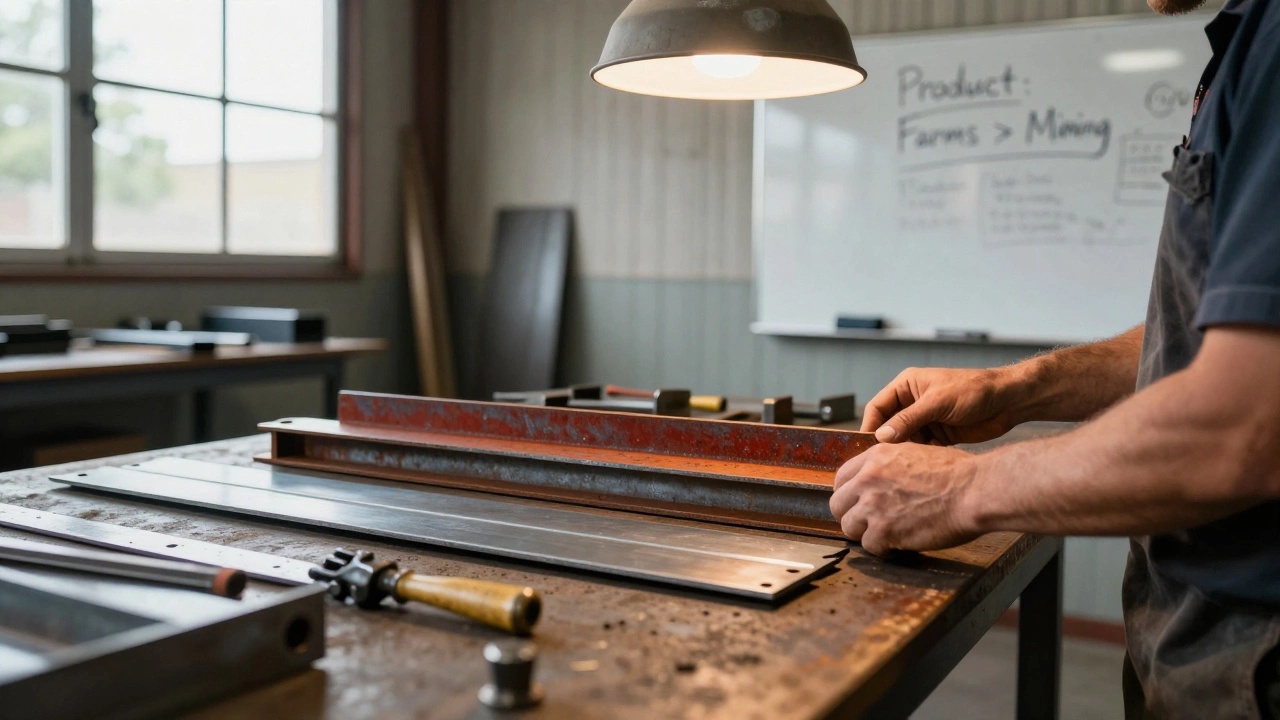
Take a small metal fabrication shop in Adelaide. They spent six months making custom brackets for mining equipment. Sales were slow. Then they switched to making brackets for local farms - same metal, same machines, but now the customers were nearby, needed them fast, and paid on time. The product changed. The business turned around.
Ask yourself: Is your product easy to make with your current tools? Can you make it consistently? Do your customers actually want it - or are you making it because you think it’s cool? If you can’t answer these clearly, you’re building in the dark.
Process: How You Make It Determines Your Profit
The process is your recipe. It’s the sequence of steps from raw material to finished product. A bad process means wasted time, scrap, rework, and angry workers. A good one is repeatable, safe, and fast.
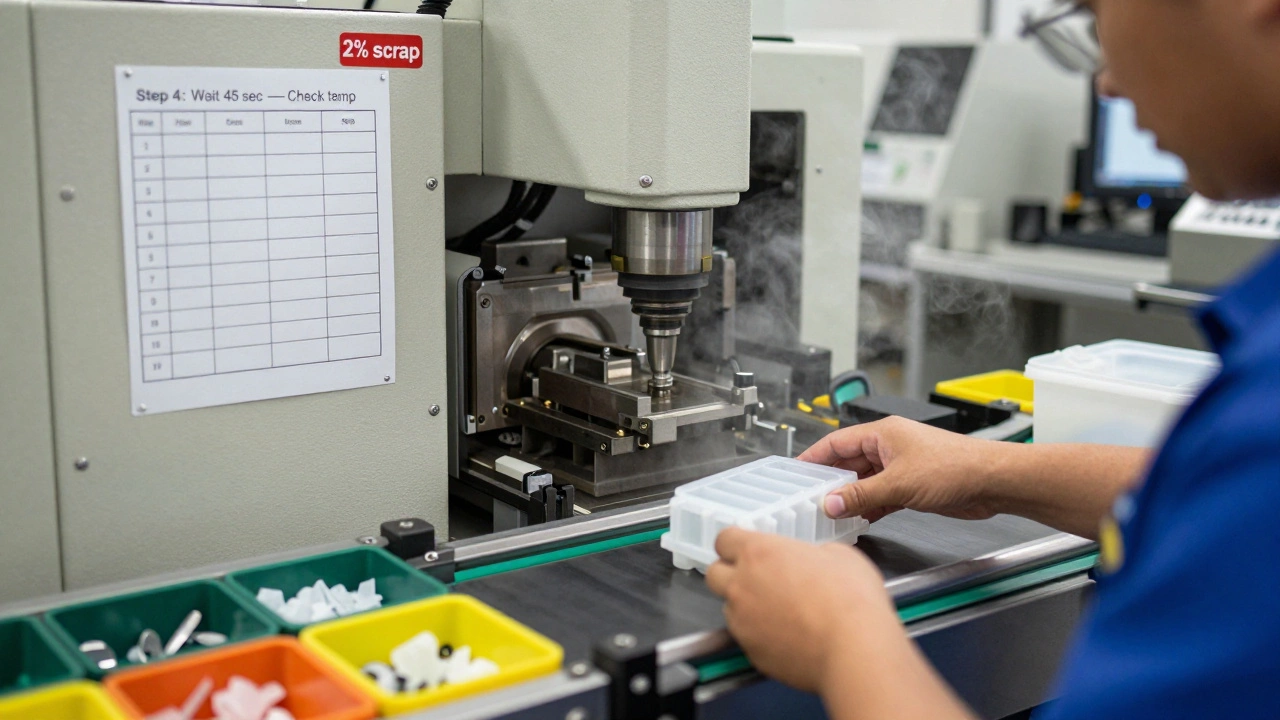
One plastic injection molding company in Geelong was losing 15% of every batch to defects. They blamed the machine. But when they mapped out the process step by step, they found the real issue: workers were pulling parts out of the mold before they cooled fully because they were on a timer, not a temperature check. Fixing that one step cut scrap to 2%. That’s $80,000 a year saved.
Every manufacturing process should be documented. Not in a 50-page manual. Just a simple checklist: Step 1: Load material. Step 2: Set temperature to 185°C. Step 3: Wait 45 seconds. Step 4: Remove part. Step 5: Inspect for flash. If it’s not written down, it’s not controlled. And if it’s not controlled, it’s not scalable.
Plant: Your Factory Layout Is a Silent Worker
Your plant isn’t just the building. It’s the flow. The distance between machines. The location of storage. The path your materials take. A bad layout creates bottlenecks. A good one makes everything feel effortless.
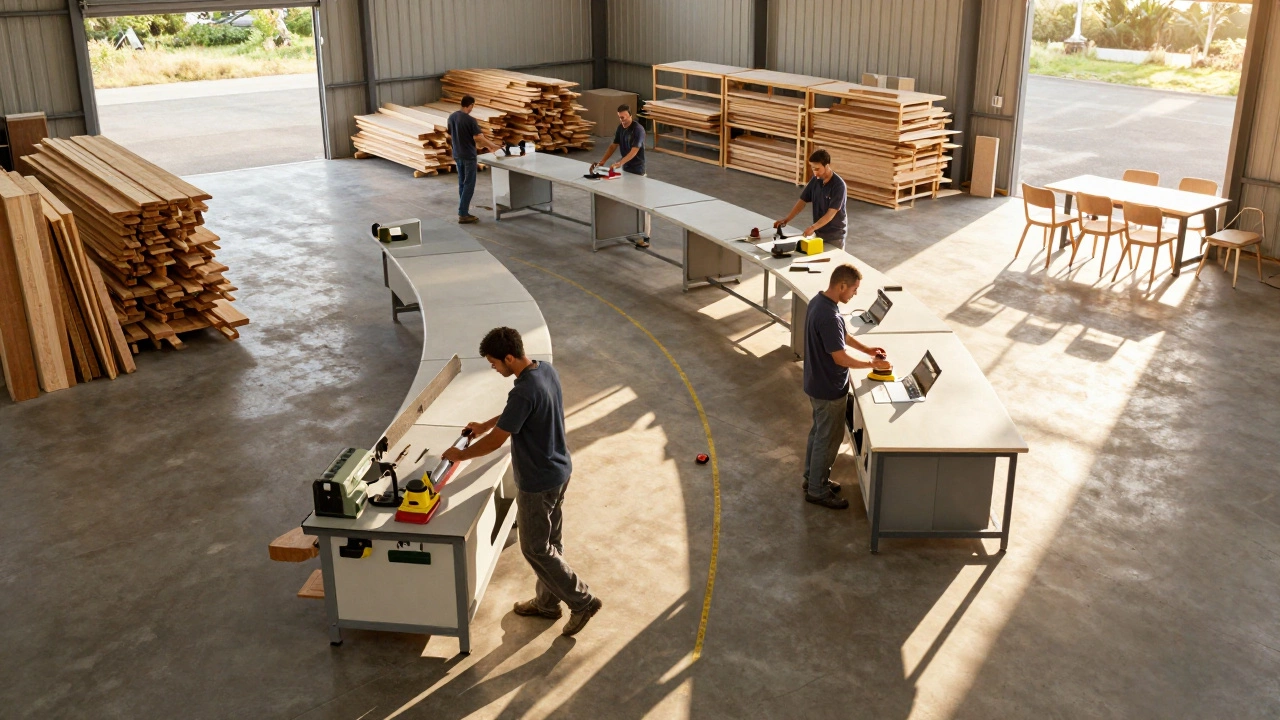
Think of a furniture maker in regional Victoria. They had their saws, sanders, and assembly tables in a straight line across a 30-meter room. Workers walked 200 meters a day just moving parts between stations. They reorganized into a U-shape - now everything is within 5 meters. Production time dropped by 30%. Workers were less tired. Fewer parts got damaged.
Follow the rule: materials should flow in one direction, with no backtracking. Keep high-use tools close to the work area. Store raw materials near the start. Finished goods near the exit. If you’re constantly moving stuff across the floor, you’re paying for labor you don’t need.
People: Your Team Is Your Biggest Asset - or Your Biggest Risk
Technology changes. Machines break. But people? They learn. They adapt. They notice when something’s off before it becomes a problem.
One electronics assembler in Brisbane had high turnover. They thought it was the pay. But when they talked to the team, they found out no one knew why their job mattered. They were just plugging in wires all day. So the owner started a simple practice: every Monday, someone from the team showed how their work connected to the final product - like how their connectors helped a medical device work safely. Morale jumped. Turnover dropped by 60% in six months.
Training isn’t a one-time event. It’s daily. Give people ownership. Let them suggest improvements. Pay attention to who’s quiet - they often see the problems no one else does. A good manufacturer doesn’t just hire workers. They build a team that cares about the output.
Planning: The Only Way to Stay Ahead of Chaos
Planning isn’t about fancy Gantt charts or ERP systems. It’s about knowing what to make, when, and with what. Most small manufacturers react. They wait for orders, then scramble. That’s expensive. Smart ones plan ahead.
A small food processing plant in Perth used to run out of packaging every other week. They’d rush orders, pay premium shipping, and lose customers. Then they started tracking usage: how many units they sold per week, how much packaging each unit needed, and how long it took to get new stock. They began ordering two weeks in advance. No more emergencies. No more overtime.
Start simple: track your top 3 products. Know your lead times - for materials, for machines, for delivery. Keep a buffer of 10-15% for unexpected demand. Don’t overstock, but don’t run on empty either. Planning turns chaos into control.
Putting It All Together: The 5 Ps in Action
These five aren’t separate. They feed into each other. A better product might need a new process. A new process might need a different plant layout. A better layout means less stress on your people. And better people make better plans.
Imagine a small battery pack assembler. They changed their product from a generic pack to one with a built-in USB-C port - now they could charge phones faster. That meant a new process: adding a circuit board. That required a new workstation with soldering stations. That meant moving machines around - better plant layout. They trained their team on the new soldering technique. And they started planning production around phone launch dates. Sales doubled in nine months.
You don’t need to fix all five at once. Pick one. Fix it. Then move to the next. But never ignore them. The 5 Ps are the foundation. Skip one, and the whole thing wobbles.
Frequently Asked Questions
Are the 5 Ps of manufacturing only for large factories?
No. The 5 Ps work best for small and medium factories. Large companies often have teams and software to handle each piece. Small shops don’t. That’s why the 5 Ps are so useful - they’re simple enough for one person to manage but powerful enough to scale. A single owner-operator can use them to run a profitable shop without hiring a consultant.
Can I use the 5 Ps with government manufacturing grants?
Yes. Many Australian government schemes, like the Modern Manufacturing Initiative or state-based SME grants, require you to show you have a clear plan for growth. The 5 Ps give you exactly that. When you apply for funding, you can say: ‘We improved our product design to meet new safety standards, streamlined our process to reduce waste by 20%, redesigned our plant layout to cut movement time, upskilled our team in automation, and now we plan production six weeks ahead.’ That’s a strong, credible case.
What’s the most common mistake manufacturers make with the 5 Ps?
They focus only on the product. They think if they build something better, sales will follow. But if the process is messy, the plant is chaotic, the team is unmotivated, and there’s no planning - even the best product will fail. The 5 Ps are a system. One broken piece ruins the whole thing.
Do I need software to manage the 5 Ps?
No. Many small manufacturers use paper checklists, whiteboards, and spreadsheets. A simple Excel sheet tracking weekly production, material usage, and defects works better than expensive software if no one uses it. Start with what you have. Only add software when you’re ready to scale - and only if it solves a real problem you’re already seeing.
How often should I review the 5 Ps?
Every quarter. At least. If something changes - a new machine, a new customer, a new material - review all five. Don’t wait for a crisis. The best manufacturers treat the 5 Ps like a health check. Small adjustments every few months prevent big problems later.
Next Steps
Start today. Pick one of the 5 Ps - the one that’s causing you the most stress right now. Write down what’s wrong. Then write down one small thing you can fix in the next week. Maybe it’s labeling your tool bins. Maybe it’s asking your team for feedback on the assembly line. Maybe it’s tracking how many units you sell each week.
Don’t try to fix everything. Just fix one thing. Then move to the next. That’s how great manufacturers are made - not by big investments, but by small, smart, consistent choices.

Recent Posts
-
Who Makes Steel for the US Military? Top Defense Suppliers and Domestic Plants
-
What Are Food Processing Units? A Complete Guide to Types, Operations, and Business Setup
-

Which Wood Is Strongest in India? A Guide for Furniture Manufacturers
-

How Many Plastic Companies Are There in the US? (2026 Industry Data)
-
What is the most in demand manufacturing? High-growth small scale ideas for 2026